
What world’s first ‘sperm race’ in LA really meant for male fertility
 We’ve seen some weird and wonderful races in our time, but away from the UK’s deadly cheese-rolling race or Wales’ World Bog Snorkelling Championship, we might have found a new contender for the world’s weirdest.
That’s right, Los Angeles has held host to the world’s first sperm race…but with good reason.
Millions of competitors were ‘donated’ by 19-year-old Asher Proeger and 20-year-old Tristan Mykel, with the pair committing to regular exercise, ensuring they were getting at least eight hours of sleep each night, and even giving up alcohol. This was all to help make sure their little swimmers were up to scratch.
The Times reports how 400 spectators crammed into an LA film studio for a night of lewd jokes and tadpole-shaped toys.
The big moment came when they watched powerful microscopes project the sperm race onto a massive screen.


There’s an important message behind Sperm Racing (Sperm Racing Instagram)
The Hollywood Palladium has been the original venue choice, but after it pulled out due to press coverage, Los Angeles Center Studios helped Sperm Racing get out of this ‘sticky’ situation.
Two ring girls in skimpy outfits paraded Proeger and Mykel’s samples, which were then loaded into a ‘microfluid device’ ahead of the big race.
After Mykel won the first race and Proeger evened the score in the second, they were then put in plastic tubes, with the loser of the third race going to be covered in white slime.
It was a close-fought race, but in the end, Mykel was the victor.
Despite the jovial nature, the world’s first sperm race was designed to raise awareness for the ongoing male fertility crisis.
Sperm has been in the news a lot recently, with sperm-injecting AI robots, and biohacker Bryan Johnson trying to de-age his penis. Elon Musk even offered his own swimmers to help populate Mars, with the world’s richest man speaking out on the supposed fertility crisis when he said: “Population collapse due to low birth rates is a much bigger risk to civilization than global warming.”
As the brainchild of 17-year-old Eric Zhu, Sperm Racing is a start-up that’s already raised over $1.5 million.
The event included advice from fertility expert Stephanie Sabourin, explaining how diet and exercise are key to keeping your sperm healthy. Still, age is a major factor, which might be why the average age of fatherhood in the USA rose from 27.4 in 1972 to 31.5 in 2022.
Allan Pacey, professor of andrology at the University of Manchester, warned: “Layer onto this poor lifestyle choices, such as high alcohol intake, smoking — although this is declining — and poor diet, and you can see how it appears that male infertility is getting more prevalent.
“Men can of course clean up their lifestyle, and many do. But cleaning up your lifestyle probably can’t undo the effects of ageing.”
US Health Secretary Robert F. Kennedy Jr. has blamed microplastics, telling Fox News: “A teenager today, an American teenager, has less testosterone than a 68-year-old man. Sperm counts are down 50 per cent and girls are hitting puberty six years early.” Still, there’s no scientific evidence to back up RFK’s claims.
Even though the message behind Sperm Racing seems to be a noble one, data analyst Nate Wooding told The Times that he was suspicious of how betting seemed to be pushed by the organisers as he concluded: “It seems like it’s a money-making endeavour.”
Featured Image Credit: Sperm Racing / YouTube


Disturbing simulation reveals what really happens to your body after injecting Ozempic
The video explains exactly how Ozempic makes you lose weight

Ozempic has become all the rage over the past couple of years as countless individuals, including a number of high-profile celebrities, are using the drug to lose a significant amount of weight – but a new simulation shows exactly how it works in disturbing fashion.
Exercise and diets have been the tried and tested routes for anyone wanting to shed some pounds, and while you can walk great lengths or even go for a run every single day, sometimes you need a little help or want to make the process a bit easier.
That’s where GLP-1 inhibitors – known broadly under names like Ozempic, Wegovy, and Mounjaro – come in as they dramatically effect how your body functions to allow you to lose weight more efficiently.
Elon Musk has previously argued that using GLP-1 inhibitors would ‘save America’s health crisis’, backing it up by using one himself over the holiday period, and a number of other key celebrities like Oprah Winfrey and Rebel Wilson have discussed their use of the drug to lose weight.
However, while its results are hard to deny, it can cause a number of worrying side effects which have been revealed in great detail through a new simulation.
Created by Zack D. Films on YouTube, known for his informative and often hilarious simulations, one of his newest videos shows the scientific process of what happens to your body when you take a GLP-1 inhibitor like Ozempic.
The first thing you’ll encounter after taking Ozempic and allowing it to pass through your blood stream is a reduction in your appetite, as the drug specifically activates the parts of your brain that signal that you’re full.
Additionally, your blood sugar is stabilized by the drug in order to avoid sudden cravings, which often amount to unhealthy treats that will cause you to gain weight at a faster rate.
It also slows down how fast your stomach empties food, which will contribute to a reduced feeling of hunger across a longer period of time, which is essential to making you eat less.
While Ozempic is not a magic bullet by any means which makes you lose weight with zero effort, it should in theory noticeably reduce the amount that you’re eating every day, which over time will quickly allow you to drop some pounds.
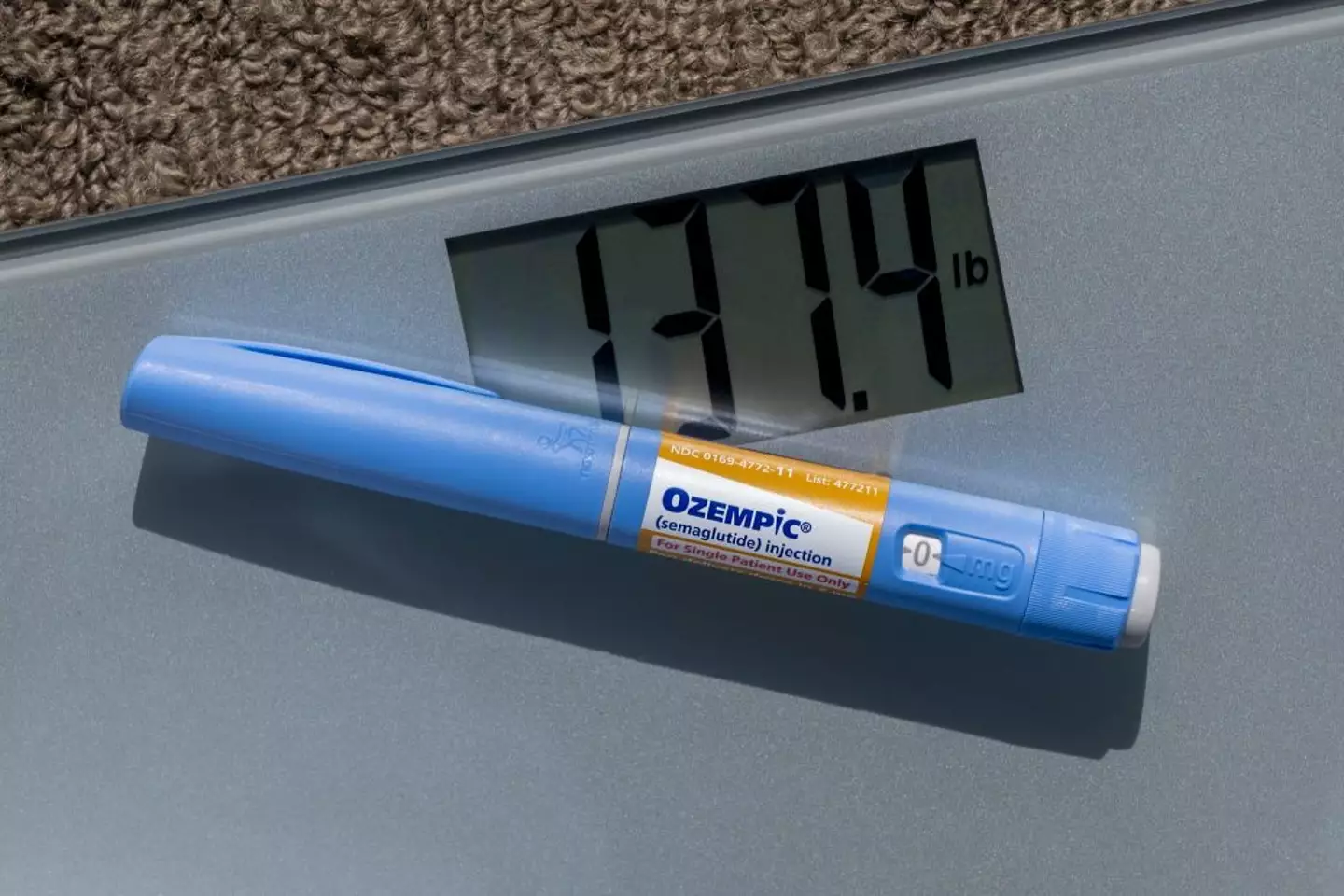
Ozempic stops you from eating in a number of different ways (Michael Siluk/UCG/Universal Images Group via Getty Images)
Like almost every other weight loss method though, Ozempic isn’t free of side effects. Most commonly it’ll make some people feel sick – which is a feature that it shares with the Keto diet, another popular weight loss method.
Additionally, it can even lead to diarrhea, which Zack has wonderfully recreated in the simulation through a trail of poo as our Ozempic-taker runs to the toilet.
“Tbh, watching Zack’s animations make me lose my appetite more than Ozempic,” writes one user in reaction to the ending, with another adding that “the detailed visuals and auditory EFFECTS are GOLD.”
Regardless of the hilarity of Zack’s animations, it goes to show that it isn’t the magic cure-all drug that you might expect, and it comes with challenges that you’d have to be willing to face – especially as Ozempic specifically isn’t FDA approved at this point in time.
Featured Image Credit: Zack D Films


Scientists create world’s first ‘black hole bomb’
This experiment could lead to a better understanding of black holes and dark matter

Scientists have created the world’s first ‘black hole bomb’ and it could help experts better understand the space phenomenon.
The theory of the black hole bomb was first proposed by physicist Roger Penrose back in 1971.
The idea was that the angular momentum of a moving black hole and the energy that creates could be transferred to a particle close to the black hole.
Two years on from that, another scientist, Yakov Zeldovich, made the discovery that a similar process could take place in other situations.
This includes things like light moving around a fast-spinning metal cylinder.
Zeldovich also believed that if you surround the rotating cylinder with a cylindrical mirror then the energy could be reflected and built up in a positive feedback loop.
This will occur until the energy is vented out or it explodes, producing a black hole bomb.


Scientists conducted an experiment to create a ‘black hole bomb’ (Cavan Images/Luca Pierro/Getty Images)
This theory of extracting energy has finally been put to the test, although thankfully, this was on a much smaller scale.
Instead of using a real black hole in outer space to try out the idea, instead physicists experimented with a safe toy model, although the principles are identical.
Vitor Cardoso, who is from the University of Lisbon in Portugal, spoke to New Scientist about the revelation, where he said: “You throw a low-frequency electromagnetic wave against a spinning cylinder, who would think that you get back more than what you threw in? It’s totally mind boggling.”
He went on to say: “Having accurate measurements in the laboratory of this process really allows you to confidently say, ‘yes, this must happen in black hole physics as well’.”


This could give scientists a better understanding of how black holes work (Science Photo Library – MARK GARLICK/Getty Images)
Hendrik Ulbricht, who conducted the experiment with a team at the University of Southampton in the UK, explained: “We’re basically generating a signal from noise, and that is the same thing that happens in the black hole bomb proposal.”
This test has the potential to help scientists gain a better understanding of how the phenomenon works and could lead to more insight on things including dark matter.
Cardoso added: “If new fields exist, we should be seeing, for instance, gravitational waves being emitted from this cloud around black holes, or we should see black holes spinning down because they’re giving their energy away to these new particles.
“So superradiance is turning black holes into particle detectors, and much better particle detectors than [the Large Hadron Collider at] CERN can be for this type of dark matter.”
Featured Image Credit: Science Photo Library – MARK GARLICK/Getty Images


World’s first non-verbal Neuralink patient speaks out after receiving Elon Musk’s brain chip
The patient wrote a tweet using his mind after having the brain chip implanted
The world’s first non-verbal Neuralink patient has spoken out after receiving Elon Musk’s brain chip.
Bradford G Smith became the third person in the world to receive the life changing chip and the first ever non-verbal person to have it implanted.
This is after Smith’s Amyotrophic Lateral Sclerosis (ALS) condition deteriorated, leaving him unable to speak.
On Sunday (April 27), Bradford took to social media to share the results of the procedure.
On X, formerly Twitter, he wrote: “I am the 3rd person in the world to receive the @Neuralink brain implant.
“1st with ALS. 1st Nonverbal. I am typing this with my brain. It is my primary communication.
“Ask me anything! I will answer at least all verified users!
“Thank you @elonmusk!”

I am the 3rd person in the world to receive the @Neuralink brain implant. 1st with ALS. 1st Nonverbal. I am typing this with my brain. It is my primary communication. Ask me anything! I will answer at least all verified users! Thank you @elonmusk!
One user replied: “How do you control which thoughts get typed and which thoughts you keep private? The normal border between internal and external dialogue is not there for you.”
This prompted a reply from another person who explained: “He explains in the video that he types. He has little to no controlled movement of his hands, so they configured the Neuralink to be controlled by his tongue for typing and a grimace or clench for a click. Fascinating to watch. He also has AI via Grok 3, which follows conversation and offers prompts that he can pick from that helps to speed up conversation for him. If he doesn’t like the prompts, he can always type instead.”
Smith added: “Exactly!”
In a video posted to Musk’s social media platform, where he said that uses the Neuralink implant to control the cursor on his laptop.
As well as this, he can use Grok AI to create a clone of his own voice to speak.
Noland Arbaugh became Neuralink’s first patient to test the neurotech firm’s chip, having it implanted in January 2024.
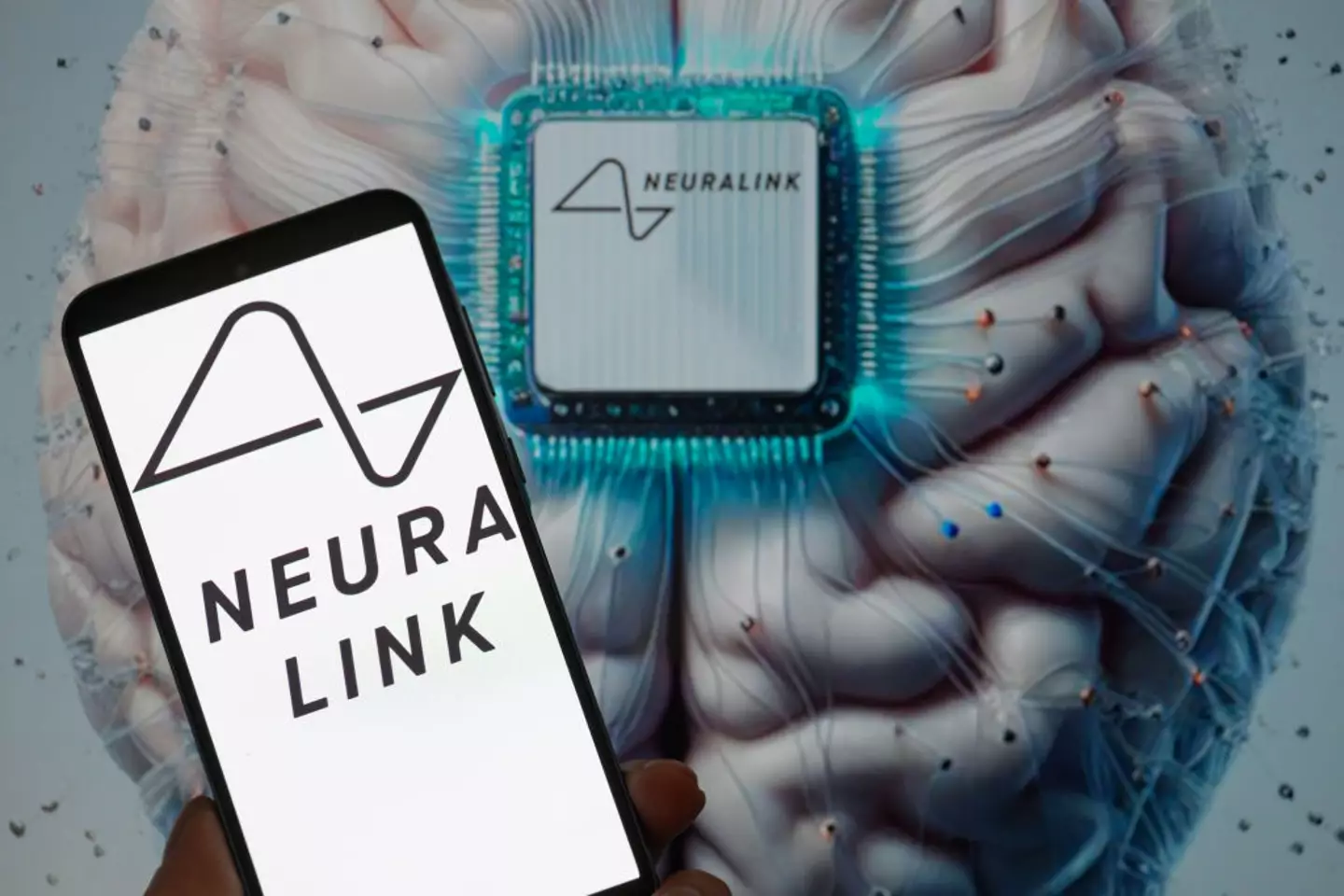
Elon Musk’s Neuralink brain chip is proving to be life changing for its patients (Jonathan Raa/NurPhoto via Getty Images)
This was eight years after he was paralysed in a diving accident.
Recalling his adjustment to his disability, Arbaugh told the BBC that he has ‘no control, no privacy, and it’s hard’, adding: “You have to learn that you have to rely on other people for everything.”
Arbaugh continued: “If everything worked out, then I could help being a participant of Neuralink. If something terrible happened, I knew they would learn from it.”
The 30-year-old hoped that by having the chip implanted, he might be able to regain some independence by being able to control his computer again.
After growing up playing video games, Arbaugh noted that this was something he’d ‘had to let go of’ after becoming disabled, however that’s all changed thanks to the chip.
He said: “Now I’m beating my friends at games, which really shouldn’t be possible but it is.”
Featured Image Credit: Jonathan Raa/NurPhoto via Getty Images


Baby conceived using AI sperm-injecting robot born in historic world-first
It could be a medical breakthrough for those trying to conceive
Medical science has just taken another major leap forward, as the world’s first baby to be conceived by a robot has just been born. While it’s not quite in the sci-fi realms of Westworld, doctors have seemingly cracked the ability to fertilize an egg with the help of a sperm-injecting AI robot.
In vitro fertilisation (IVF) is designed to help those struggling to have a baby, leading to several ways to fertilize an egg. One popular method is intracytoplasmic sperm injection (ICSI), which deals with cases of male infertility. Here, a single sperm cell is injected into mature eggs, taking away the typical journey of sperm having to swim to reach an egg. If successful, the embryos are then inserted into the uterus. Another popular method of IVF is to mix the eggs with sperm in a lab dish, but as these have been around for a while now, the medical industry is adopting a futuristic new method that shows artificial intelligence can do some good.
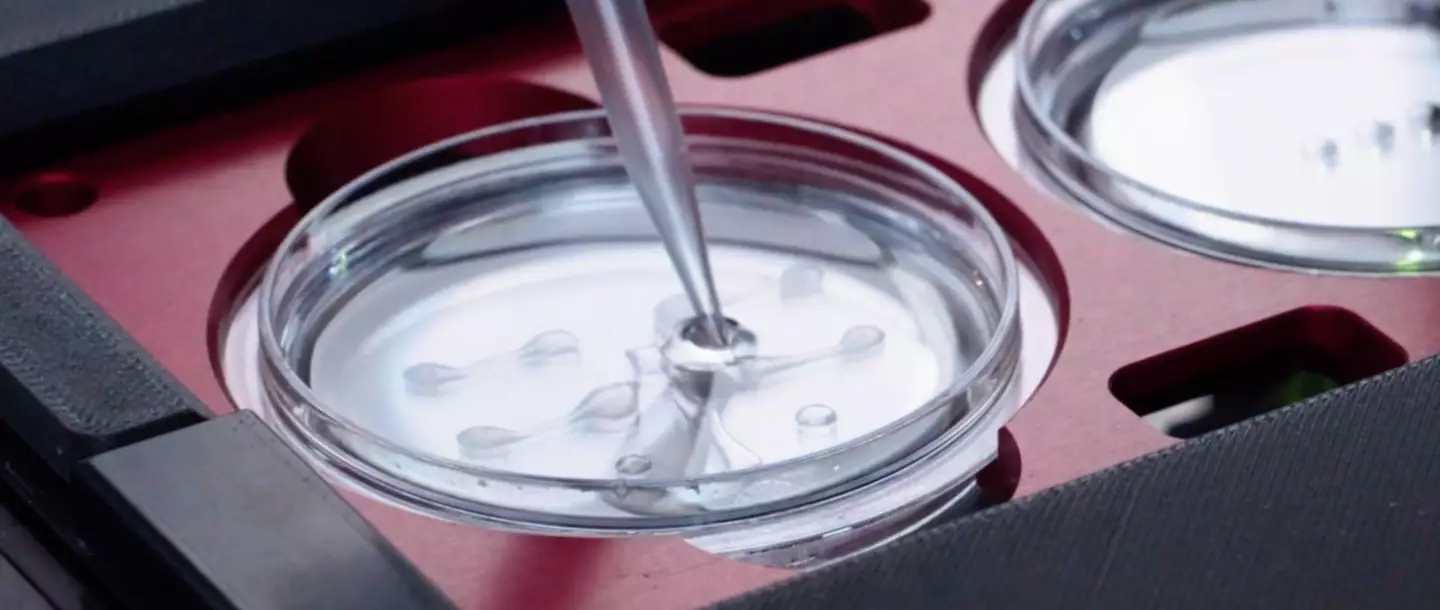
Conceivable Life Sciences has automated the ICSI process (Conceivable Life Sciences)
ICSI is seen as more accurate, but with it, there still comes human error. As Jacques Cohen at Conceivable Life Sciences told New Scientist, ICSI is typically performed manually by skilled embryologists who have to use microinjection systems. Studies have shown that the skill of ICSI embryologists can vary massively, with Cohen adding: “They become tired and distracted sometimes, just like everybody else in most professions, so errors happen that can reduce [the] odds of fertilisation and births.”
Hoping to lead to a higher success rate with ICSI, Cohen and the team have created a robot that can perform 23 ‘key steps’ of ICSI. Although each one is triggered by a human operator at the press of a button as they watch a stream of the process, it can be performed remotely from anywhere in the world.
Using AI, the machine selects the healthiest sperm with the best chance of fertilization based on its appearance. Another step involves zapping the sperm’s tails with a laser, therefore making them easier to pick up and be injected into the eggs.
Even though a similar method has been tried before and resulted in two live births, not all of the steps were automated.
In the latest experiment, the Conceivable Life team recruited a couple where the man had sperm with low mobility. As the woman struggled to produce eggs, donor ones were also used.
Five of eight donor eggs were randomly fertilized by the new system and produced four embryos. The other three eggs were fertilized with the traditional ICSI methods, and all formed embryos.
A different AI model then selected the two ‘best’ embryos by looking at the appearance of the chromosomes, and it turns out that both were produced with the robot system. Cohen admits that this doesn’t mean the robot produced healthier embryos due to the small sample of eggs involved.
Although one of the embryos failed to develop after being inserted into the woman’s uterus, the other led to a successful birth. Even though Joyce Harper at University College London referred ot it as an exciting proof of concept, larger studies need to be undertaken to prove that automated ICSI procedures are superior to manual ones.
Despite this being a seemingly big step in the realm of IVF, Harper suggests it’s likely to be adopted on a wider scale due to the extra costs involved. Still, Cohen is hopeful for the future and concluded: “As we optimise, standardise and refine the system, we expect the cost to the patient and clinic to decline.”
Featured Image Credit: Conceivable Life Sciences

20 Years Later, The Natalee Holloway Mystery Is Finally Solved, And It is Bad

Recent Research Sheds Light on the Effects of Cannabis on the Brain

Gynecologist Refuses to Treat Trans Woman, Sparking Backlash Over Refused Care
About The Author
